Trump Accounts: What They Are, How They Work, and Where They Fit

Trump Accounts are a new type of savings account for children, created by the One Big Beautiful Bill Act and available starting July 4, 2026. They work similarly to a traditional IRA: contributions grow tax-deferred, and withdrawals in retirement are taxed as ordinary income. Parents, grandparents, and even employers can contribute up to $5,000 per year. Children born between 2025 and 2028 are eligible for a $1,000 contribution from the federal government. During the child’s minority years, the money must be invested in a U.S. stock index fund and cannot be withdrawn without penalty until age 59½.
Headlines have focused on a scenario where maximum contributions over 18 years, followed by a Roth conversion in the child’s early twenties, could grow to $3 million by retirement. That outcome is achievable, but it depends on a specific assumption: that outside dollars, not the account itself, are used to pay the conversion tax. Without that, the after-tax advantage over a plain taxable custodial account narrows to a relatively small margin. For families in states like California, Massachusetts, or Pennsylvania that plan to tax annual TA earnings, the federal advantage shrinks further.
Whatever you decide about long-term strategy, one step is worth taking now: enroll to capture any available free contributions. The Trump Accounts app from BNY Mellon and Robinhood is live in the Apple and Google app stores. Families not yet enrolled can sign up at TrumpAccounts.gov.
One of the more talked-about features of the One Big Beautiful Bill Act, signed into law on July 4, 2025, is a new type of savings account for children called the Trump Account. A recent Wall Street Journal article illustrated how a family that contributes $5,000 per year from birth through age 17 and then converts the account to a Roth IRA at age 24 could end up with $3 million tax-free by retirement. It is a striking number, and it is worth understanding exactly what it takes to get there and how it stacks up against what families are already using.
How Trump Accounts Work
A Trump Account (TA) is best understood as a modified traditional IRA for minors. Starting on July 4, 2026, one can be opened on behalf of any child from birth through age 17. The key differences from a standard IRA are that contributions do not require the child to have earned income, and multiple parties can contribute, including parents, grandparents, employers, and even the federal government.
On the contribution side, individuals can contribute up to $5,000 per year in after-tax dollars. Employers can add up to $2,500 of that $5,000 on a pre-tax basis, and that amount is excluded from the employee’s taxable income. Separately, as a temporary pilot program for children born between 2025 and 2028, the federal government will contribute $1,000 to open the account, provided a parent affirmatively elects it. The Dell family has also pledged $250 per child for children under age 10 who live in zip codes with median household income below $150,000, though the mechanics of that contribution are still being worked out and do not yet appear in IRS guidance.
One constraint worth knowing: during the child’s minority years, Trump Accounts must be invested in U.S. stock index funds with no leverage and annual fees capped at 0.1%. Cash and money market funds are generally not permitted. This is a meaningful limitation compared to a custodial account, where the trustee can invest in anything.
Money cannot come out at all until the year the child turns 18, and there are no hardship exceptions before that. After 18, a Trump Account follows the same rules as a traditional IRA: withdrawals before age 59 and a half trigger a 10% penalty unless an exception applies, all growth is taxed as ordinary income on the way out, required minimum distributions eventually kick in, and most non-spouse heirs will face the SECURE Act’s 10-year rule. In most respects, a Trump Account that has grown for 60 years will create the same tax planning challenges that many large traditional IRA owners are dealing with today.
A Note on State Taxes
The federal tax treatment of Trump Accounts gets most of the attention, but state taxes are a meaningful consideration that many projections leave out entirely. Several states are planning to tax annual investment earnings inside Trump Accounts, which would eliminate one of the account’s primary advantages: the ability to compound without a tax drag on annual income. As of this writing, states that have indicated plans to tax TA earnings include California, Hawaii, Kentucky, Massachusetts, Pennsylvania, South Carolina, and Wisconsin.
Some of those states may also tax employer contributions to the account, which would further reduce the benefit of the pre-tax employer contribution feature. State-level rules are still evolving, and more states may conform or diverge from federal treatment as guidance develops.
If you live in one of those states, the comparison with a taxable custodial account shifts further in the custodial account’s favor. A custodial account in a tax-efficient ETF generates relatively little taxable income year to year, and what it does generate is taxed at capital gains rates. The TA’s state tax exposure hits the full earnings of the account annually, which chips away at the compounding benefit the account is designed to deliver.
The Bull Case: The WSJ’s $3 Million Scenario
The Wall Street Journal described the strategy as the real power play: contribute $5,000 per year for 18 years, then help the young adult convert the balance to a Roth IRA at around age 24, after the kiddie tax rules no longer apply. At a 7% annualized return, the account would be worth roughly $278,000 at age 24. Converting to Roth would trigger a tax bill of approximately $43,550. The account would then compound tax-free until retirement, arriving at around $3.07 million by age 59 and a half.
The strategy works, and the math checks out. But there is one assumption doing most of the heavy lifting, and the article states it briefly:
"The child would owe the tax on the Roth conversion, but parents or grandparents could pay it as an additional gift. We assume the tax is paid with non-IRA dollars, instead of from money being converted." — Wall Street Journal, March 24, 2026
That is the key detail. To reach $3 million, parents need to contribute $5,000 per year for 18 years ($90,000 total) and then write a separate check for roughly $43,550 in conversion taxes when the child is in their mid-twenties, bringing the total commitment to around $135,000. The WSJ article itself acknowledges this is a strategy for “a wealthy person.”
More importantly, what happens if the conversion tax has to come from inside the account rather than from outside? If the young adult cannot find outside dollars to cover it, the funds withdrawn to pay the tax are subject to ordinary income rates plus a 10% early withdrawal penalty on the taxable portion. The amount that actually ends up in the Roth drops meaningfully, and the long-run advantage of the strategy narrows considerably.
If You Do Use a Trump Account: Getting the Most Out of It
For families who decide a Trump Account is the right tool, execution requires more planning than most headlines suggest.
The core strategy is to contribute the maximum each year and convert the balance to a Roth IRA as soon as it makes sense to do so. The timing of that conversion matters a great deal. As discussed above, the kiddie tax rules can apply to unearned income, including taxable IRA distributions, for dependents through age 23 in some cases. Converting while a child is still a dependent and subject to the kiddie tax could mean paying the conversion tax at the parents’ marginal rate rather than the child’s own lower rate, which substantially undermines the benefit. In most cases, it is worth waiting until the young adult is earning income independently and is no longer claimed as a dependent before executing the conversion.
One timing detail worth knowing: each Roth conversion starts its own five-year clock. For individuals under age 59 and a half, converted principal cannot be withdrawn penalty-free until five years after the conversion. So a conversion done at age 24 means the converted principal is penalty-free to withdraw starting at age 29. That is not necessarily a problem if the goal is retirement savings, but it is worth understanding if the child might need access to funds in the near term.
Who actually pays the conversion tax is a question worth settling well before the child turns 18. If parents or grandparents plan to cover it as a gift, they need to have that liquidity available at the right time. If the expectation is that the child pays it themselves, the plan for where those dollars come from, whether earned income, outside savings, or some combination, needs to be worked out in advance rather than improvised when the moment arrives.
Perhaps the most underappreciated consideration is the conversation that needs to happen with the child before they reach age 18. A fully funded Trump Account could easily be worth $200,000 or more at that point, and the beneficiary will have withdrawal capability starting at 18 and full legal control at the state’s age of majority. That is a significant amount of money to transfer without preparation. The beneficiary will need to understand basis tracking, how to execute a Roth conversion, the tax liability that comes with it, and why a thoughtful conversion timeline is more valuable than an early withdrawal. Starting those conversations well before age 18 is part of what determines whether the strategy succeeds.
The UTMA Custodial Account: How It Compares
A UTMA (or UGMA) custodial account is a standard taxable brokerage account opened in a minor child’s name and managed by an adult until the child reaches the state’s age of majority. There is no contribution limit beyond the annual gift tax exclusion of $19,000 per person in 2026. Funds are accessible at any time without penalty, there are no investment restrictions, no required minimum distributions, and unrealized gains receive a step-up in basis at the account owner’s death. A Trump Account, by contrast, would follow the SECURE Act’s 10-year rule for most non-spouse beneficiaries.
The common criticism of taxable accounts is that investment income is taxed each year, creating tax drag. For most investors that criticism is valid. For minor children, it largely is not, because of how the kiddie tax rules work.
The Kiddie Tax Advantage
Under the kiddie tax rules, the first $2,700 of a dependent child’s unearned income in 2026 is either tax-free or taxed at the child’s own very low rate, typically 0%. That means a custodial account invested in a tax-efficient ETF can generate up to $2,700 in qualified dividends and capital gains each year with little or no tax liability. And because of how capital gains taxation works, there is a straightforward annual strategy: sell positions near year-end to realize gains up to the kiddie tax threshold, then immediately buy them back. Unlike harvesting capital losses, harvesting capital gains does not trigger the wash sale rule, so there is no mandatory waiting period.
Every dollar of gain realized tax-free under the kiddie tax rules becomes permanent basis in the account. It will not be taxed again, even if the child holds those positions for decades and eventually sells at a much higher price. By contrast, every dollar of growth inside a Trump Account remains taxable as ordinary income on the way out, no matter how long it compounds. The Trump Account’s investment restriction to U.S. stock index funds also eliminates the ability to use lower-yielding, tax-managed strategies in the custodial account to reduce dividend income and make more room under the kiddie tax threshold.
How the Numbers Compare
Kitces.com modeled both accounts side by side, assuming maximum annual contributions from birth through age 17, an 8% average annual return, and annual gain harvesting in the custodial account up to the kiddie tax threshold. At age 60, after-tax:
Taxable UTMA account: $4,947,859 after tax (pre-tax value $5,547,509)
Trump Account, held as traditional IRA: $4,779,153 after tax (pre-tax value $6,235,354)
The UTMA comes out ahead despite its lower pre-tax value, because its gains are taxed at long-term capital gains rates rather than ordinary income rates. These numbers also only reflect federal taxes. In the states planning to tax annual TA earnings, the gap grows.
Add a Roth conversion with outside dollars paying the tax, and the TA-to-Roth outcome edges ahead. Without that, the Kitces analysis puts the TA’s after-tax advantage over the UTMA at roughly $43,000 in today’s dollars across a 60-year horizon. That is not nothing, but it is also not the margin that changes the decision for most families.
Where 529 Plans Fit
529 plans are still the right starting point when education is the primary goal. OBBBA expanded the list of qualifying expenses, and the $35,000 lifetime 529-to-Roth rollover means unused education savings can flow into retirement accounts tax-free. That is actually a more efficient path to Roth money than converting a Trump Account, since the 529-to-Roth rollover carries no conversion tax. If college savings is on the list at all, a 529 deserves a look before a Trump Account.
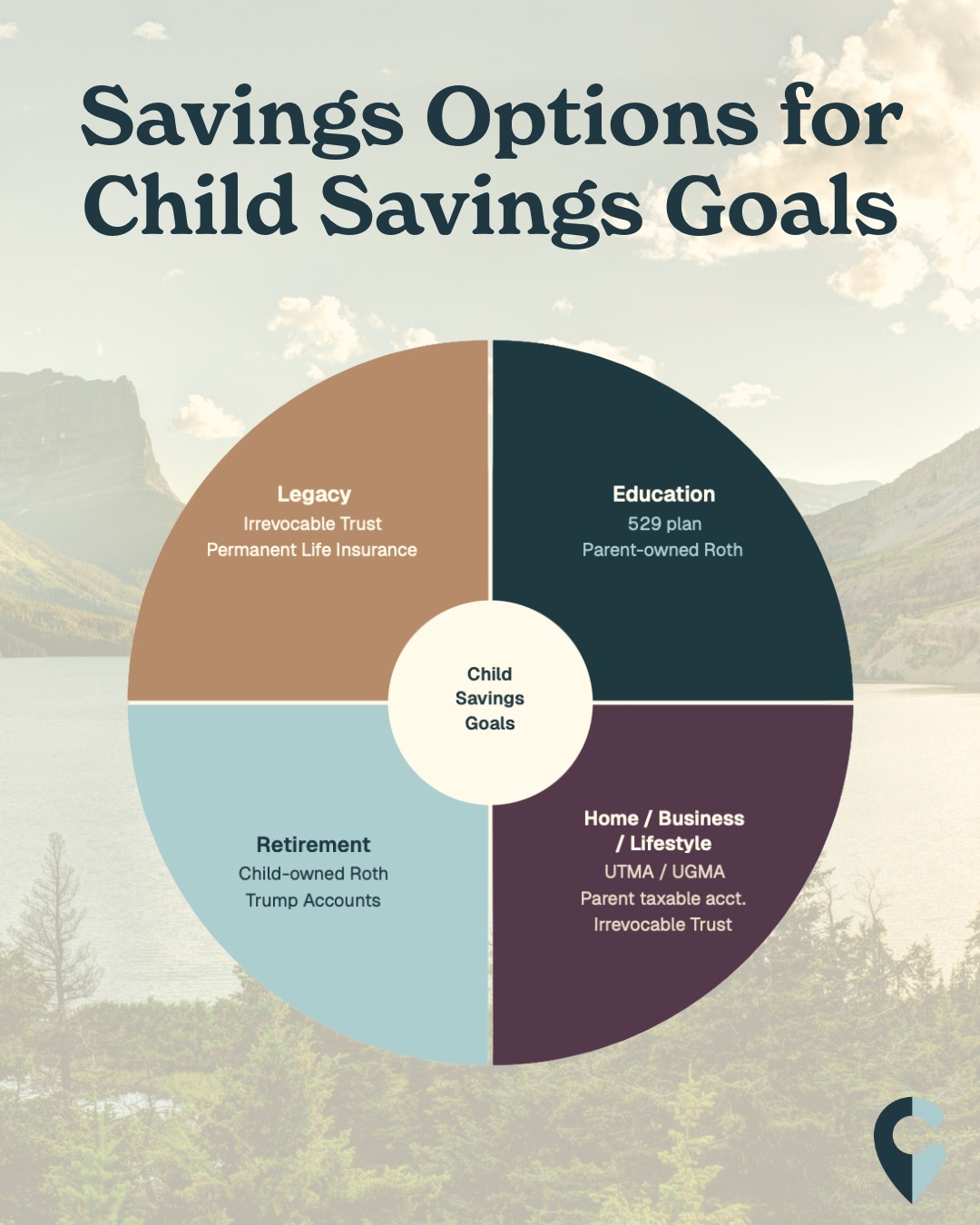
A Framework: Matching the Strategy to the Family
The right approach depends on where a family is in their financial life.
For most families: take the free money. The federal pilot contribution ($1,000 for children born 2025 through 2028), qualified general contributions from governments or charities, and employer contributions where available are worth capturing regardless of what else you plan to do. Enrolling costs nothing and does not commit to ongoing contributions.
For families that have already funded college savings and other near-term goals: supplementing with direct contributions and planning a Roth conversion at a low tax rate is worth exploring. When executed correctly, with contributions over 18 years, a conversion timed after the kiddie tax no longer applies, and outside dollars available to pay the conversion tax, the math is favorable. It requires advance planning and ongoing financial education with the child as they approach adulthood.
For everyone else: consider the highest-priority goals and choose the account type that best serves them. If education funding comes first, a 529 plan is likely the right starting point. If the goal is general long-term wealth building, a UTMA custodial account managed with annual gain harvesting produces competitive after-tax outcomes with more flexibility. That decision is worth working through carefully.
What to Do Right Now
If you have a child born between 2025 and 2028, there is one practical action worth taking regardless of where you ultimately land on Trump Accounts as a savings vehicle: enroll to receive the $1,000 federal pilot contribution. This is genuinely free money. It does not count against the $5,000 annual contribution limit, and enrolling does not obligate you to make any further contributions.
The Trump Accounts app, built by Bank of New York Mellon and Robinhood, is now available in the Apple and Google app stores. Families who have already enrolled can begin account activation there. Families who have not yet enrolled can do so at TrumpAccounts.gov. No contributions of any kind can be made until July 4, 2026, when the accounts officially open and the first $1,000 federal contributions to eligible accounts begin. The app will allow parents to schedule automated contributions and project future account balances. The default investment at launch is an S&P 500 ETF, with other broad-based index fund options expected to follow.
Trump Accounts will initially be managed exclusively through the app. Families will be able to roll them over to other participating financial institutions in the future, so the initial platform is not permanent. Children take control of the account at age 18 and can choose to continue investing or make withdrawals subject to the traditional IRA rules described earlier.
If you have a child under age 10 and live in a qualifying zip code, also watch for separate guidance on the Dell family’s $250 contribution. That program is expected to roll out through the same platform, but specific enrollment mechanics have not yet been announced.
For families who want to do more beyond collecting the available free money, my general recommendation is to direct ongoing savings to a combination of a 529 plan for education goals and a UTMA custodial account for longer-term wealth building. That combination provides tax-efficient growth, flexibility to access funds at any time without penalty, and no pre-tax IRA accumulation problem waiting at retirement.
The Bigger Point
The Roth conversion strategy can work well, and for the right family it is worth taking seriously. But it requires a lot of things to go right over a long period of time: consistent contributions for 18 years, a well-timed conversion after the kiddie tax window closes, outside dollars to cover the conversion tax, a state that does not tax annual earnings, and a young adult who understands what they have and why holding onto it matters. That is a meaningful list.
For families where some of those conditions do not apply, a taxable custodial account with annual gain harvesting gets to a comparable place with fewer constraints. Either way, what matters most is not the account type. It is starting early and staying consistent. If you have children or grandchildren you are thinking about saving for, I am happy to work through the options with you.
Keep more of what you earn. Do more of what you love.
Want to know more? Get in touch.
*Please do not send any financial information